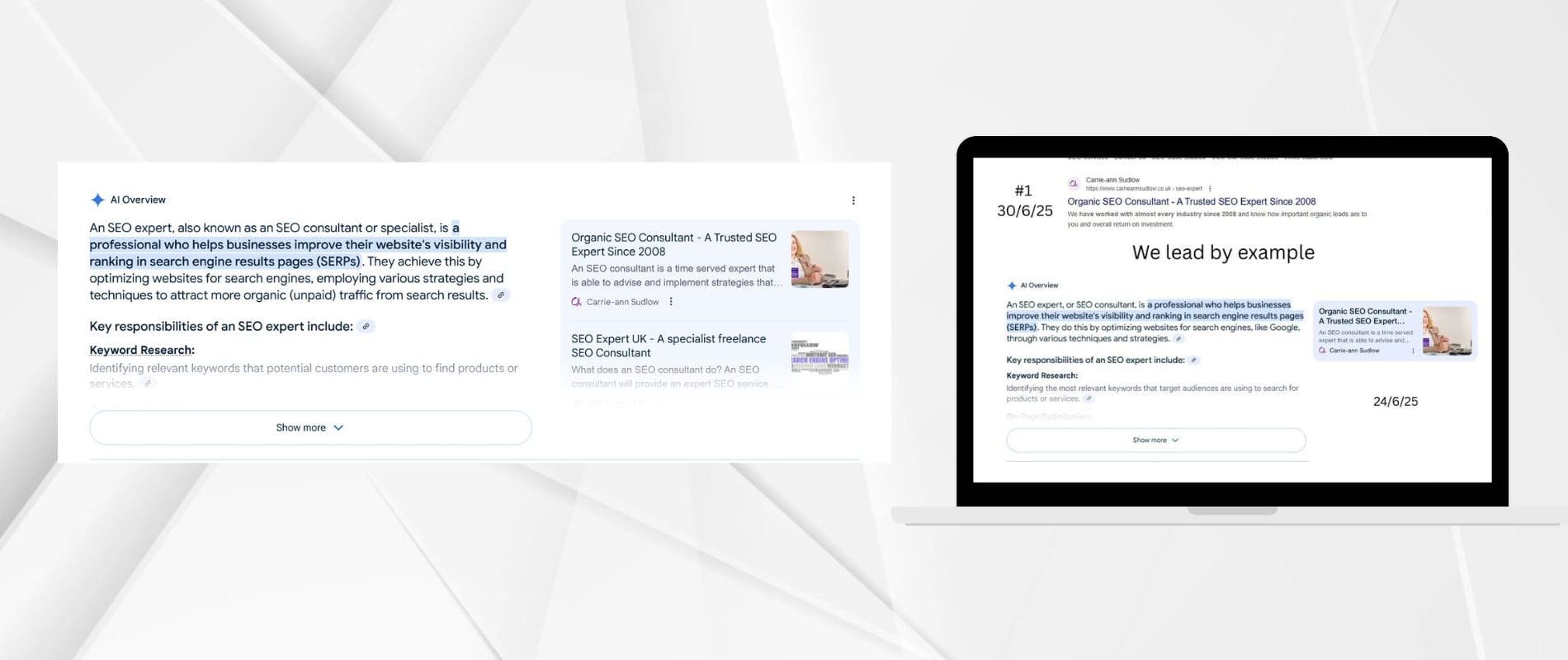
How To Rank in AI Overviews
You’ve probably noticed that when you search on Google, you’re not just getting a list of websites anymore. Now there’s a chunky box at the top giving you what looks like a little summary, like Google’s done the research for you. That’s called an AI Overview.
And if you’re a small business owner, you’re probably wondering:
“How do I get my business to show up in that bit?”
You’re not alone.
Here’s the good news:
- You don’t need to learn a load of new technical stuff
- You don’t need to panic about “ranking in AEO” or whatever fancy term someone’s trying to sell you
And you definitely don’t need to hire an SEO agency on a £5,000-a-month retainer
So, What is an AI Overview?
In simple terms, Google is now using artificial intelligence to scan loads of websites, pull out what it sees as the most helpful information, and display that at the top of search results.
Imagine Google being a well-read robot butler. It fetches answers from all over the web, squishes them into a tidy paragraph, and presents it to the searcher with a “here you go.”
But where does it get that information from?
That’s the golden question.
Google’s AI is pulling content from regular websites, ones just like yours. It’s not picking favourites because you’ve enabled some secret AI setting. Google has confirmed there’s no special tag, hidden code or magic button that guarantees you’ll appear in AI Overviews.
Instead, it looks for content that is clear, trustworthy, relevant and genuinely helpful.
Why AI Overviews Matter
AI Overviews are becoming one of the most prominent features in Google’s search results.
Instead of users clicking through multiple websites to piece together an answer, Google is increasingly providing a summary at the very top of the page.
For businesses, this creates another opportunity to build visibility and authority. If your content is selected as one of the sources behind an AI Overview, you have the chance to put your brand in front of potential customers before they’ve even started scrolling.
The goal hasn’t changed. Google still wants to provide users with the best possible answer. AI Overviews are simply another way of delivering it.
Best Practices for Appearing in AI Overviews
1. Be Helpful, Not Fluffy
Google’s AI is looking for clear, straight answers to common questions.
So instead of waffling on, get to the point.
If your customer is asking:
“How much does it cost to repaint a living room?”
Answer it directly.
Don’t dance around it with:
“Well, it depends on the mood of your decorator and the shade of blue in your aura.”
Instead, say something like:
“Most UK homeowners pay between £300 and £600 to have a standard living room repainted professionally.”
That’s exactly the sort of answer Google likes to reference.
2. Structure Matters
Use headings, bullet points and short paragraphs.
Basically, write like a human but organise like a robot.
Why?
Because Google’s AI needs to understand your content quickly.
If you’ve got one enormous wall of text, it’ll move on faster than a teenager being asked to empty the dishwasher (I know this because my teenage granddaughter Lexi lives with me).
Think about:
What’s the question my customer is asking?
What’s the clearest way I can answer it?
Use headings that mirror those questions and answer them immediately underneath.
3. Don’t Just Sell – Educate
This is the big one.
Google’s AI isn’t trying to help you sell.
It’s trying to help users learn.
If your website only says:
“Call us today for a quote!”
…you’re not giving Google much to work with.
Instead, explain:
- How your service works
- What customers can expect
- Typical costs or timescales
- Common mistakes to avoid
- Frequently asked questions
The more genuinely useful your content is, the more likely Google is to reference it.
4. Be Trustworthy
Google needs to trust your website before it shares your information.
That means:
- Clear business details
- A secure, mobile-friendly website
- Accurate and up-to-date information
- Reviews, testimonials and case studies where appropriate
- Content written by people who actually know what they’re talking about
- No need to go overboard.
Just don’t let your website look like it was last updated during the Nokia era.
5. Answer Questions People Actually Ask
This one’s pure gold.
Use Google’s “People Also Ask” section, customer enquiries, sales calls or tools like AnswerThePublic to discover the questions your customers are asking.
Then answer those questions.
In plain English.
Not keyword-stuffed nonsense.
Not SEO gobbledygook.
Just useful answers written by a real person.
Google’s AI is increasingly focused on understanding search intent rather than simply matching keywords. If your content answers the user’s question better than anyone else, you’re giving yourself a much better chance of being featured.
6. Use Structured Data
Structured data (also known as schema markup) helps search engines understand your content more clearly.
It won’t guarantee an AI Overview placement, but it does make it easier for Google to identify important information on your website.
Depending on the page, consider implementing schema such as:
- FAQ
- Article
- Organisation
- Local Business
- Product
Think of structured data as giving Google an organised filing system rather than asking it to rummage through a messy desk.
7. Write Naturally
AI Overviews are designed around natural language.
People don’t always search using short keyword phrases anymore.
Instead of searching for:
“best bakery London”
They’re increasingly asking:
“Where’s the best bakery in London that sells fresh sourdough?”
Write the way your customers speak.
Use natural language.
Answer conversational questions.
Focus on solving problems rather than forcing keywords into every paragraph.
8. Build Topical Authority
Google is much more likely to trust websites that demonstrate expertise across an entire subject rather than publishing a single article and hoping for the best.
Build related content around your main topics and connect those pages together with sensible internal links.
For example, if you’re building your AI SEO knowledge, you might also find these guides useful:
Creating clusters of helpful content makes it easier for both users and search engines to understand your expertise.
One final thing to remember: AI Overviews don’t mean SEO is dead. Google is changing how it presents information, but the fundamentals of creating helpful, trustworthy content remain the same. If you’re wondering what AI really means for the future of SEO, have a read of our article Will AI Replace SEO?, where we explore why human expertise is still just as important.
In a Nutshell
Ranking in Google’s AI Overviews isn’t about tricking the algorithm or chasing the latest AI gimmick.
It’s about doing what good websites have always done.
- Help people
- Be clear
- Share useful information
- Answer real questions
- Demonstrate genuine expertise
- Sound like a human, not a robot
SEO has evolved.
Years ago, the focus was heavily on keywords.
Today, it’s about understanding search intent, answering real questions and creating content that genuinely helps people. AI Overviews are simply another step in that evolution.
If you’re already creating genuinely helpful content, you’re well on your way.
If not, now’s the time to start.
If you’d like help improving your visibility in Google’s AI-generated search results, have a look at our AI SEO services. No fluff, no faff, just practical SEO that works.